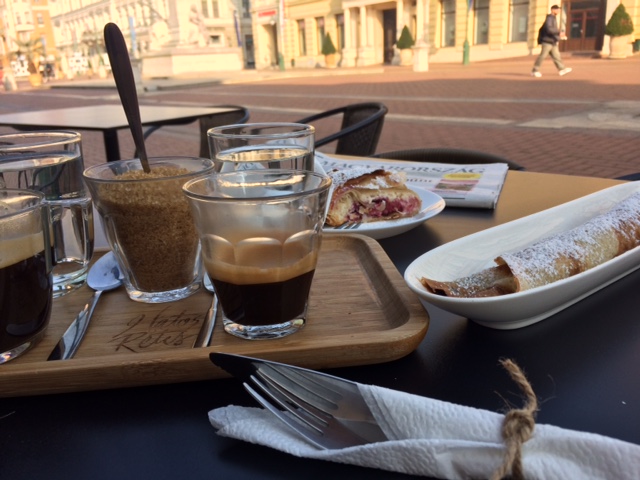
From L to R: kávé, rétes and palacsinta (a Hungarian crêpe). Yum.
Now this word means six. Or in this particular form “six-” as in six-layered rétes found at Hatos Rétes in Szeged. ‘Hah-tosh’ and ‘ray-tesh.’ There, you’ve got it. Now you’ve just got to go and taste it. But a few things first-
What is rétes?
Well, rétes is a favourite Hungarian dessert. Yes, one of many favourite desserts. It is a pastry made from an unleavened dough worked thin and oftentimes crispy thin like parchment paper. Filo, fillo, phyllo? You got it. A lot like filo-pastry. Layers of the stuff laid out and filled with glorious ground poppy seed, sugar and Hungarian sour cherries (megy), or stuffed with sweetened cottage cheese, or spiced apple, semi-sweet baking squash–oh! the list goes on and on. Make a length (like that of a small table-for-two tablecloth), fill and roll it over and over again on itself. Bake low and slow. Crisp, delicate, papery-golden brown. Cut neatly into sort of fist-sized parcels and serve. De-licious.
Now some attest that in Hungary rétes has roots in the sixteenth century and is Turkish-inspired. Balkan, too. Think baklava. Either way today’s rétes shares a likeness to certain Austrian and Serbian desserts as well. During the Austro-Hungarian Empire the rolled and filled rétes really took off. And in Hungarian tradition many a lakodalom or wedding feast is finished with this fine dessert. It has a history, it tastes good and by golly if you haven’t had some you should. There is even suggestion that back in the day the pastry flour was ordered direct from Hungary to make the dessert abroad. Pastry chefs were even sent to Budapest to learn how to make this delicate sweet.
Now that’s a lot of ingredients to the story.
Back to Szeged. As mentioned we hung out around Klauzál tér quite a bit. I mean, we don’t have lovely statuaries or cobbled squares full of ornate windows and buildings and simply divine walk-in courtyards where I’m from. So we kind of took advantage of the views here. There is so much history here–and so much to eat and enjoy.
We often visited A Cappella Cukrászda on the nearby corner, but as so often happens, with a little wandering and a willingness to try something new we stumbled across a quiet and content-looking café a few doors down. Tables were arranged welcomingly near the entrance. We noticed the low windows and the mild green exterior. We wandered up and stepped inside pulling the cafe door shut behind us.
Comfortable lighting and a few simple, cozy tables around. A glowing case full of delights like mákos and diós guba (sweet poppy seed or walnut-coated bite sized rounds of cake soaked in rich milk and vanilla–wow!) or delicately sweet linzer cookies. But where is the rétes, you ask? Well, as any good bank might they keep the goods behind the counter. And Hatos Rétes is full of ‘the good stuff.’
I’ve actually never seen so many kinds of rétes in one place. At least two dozen. I won’t list all the flavours here. You had better go and find out for yourself. Let’s just say one favourite was the sweet cottage cheese filled rétes with a bit of homemade jam (pictured above). I don’t know what else to say.
You order. You pay. You sit. You wait. You choose your roast of coffee or hot beverage. Sit in or outside. You hear the whistle and hiss of a side of local milk being steamed for your Americano. You hear the machine grumbling as it pulls your double espresso. The next thing you see is a smiling face bringing your rétes and coffee to your table. A family business, I might add. Like so many places in Hungary you find a real love for what people do. And here at Hatos Rétes it’s in the food and it’s in the service.
We came back again and again for a few days. It was the last place we visited for a morning coffee before heading for our Budapest-bound train. We got to know the owners a little. And it was a little hard to say goodbye. “Viszont látásra,” we said.
“See you again.”
And I think we will.
Now do you know what rétes is? If you don’t, then find some. If you know someone that makes it, make sure you get a taste. And if one day you happen to be in Hungary and have a little time to travel south of Budapest to Szeged,
I know a good place you ought to try . . .
 The Traveller's Typewriter